Government Camp & Barlow Road
📍 Government Camp, OR
One more day! Up and out by 0830 to see the last few spots on the Auto Tour Guide before the END OF THE TRAIL.
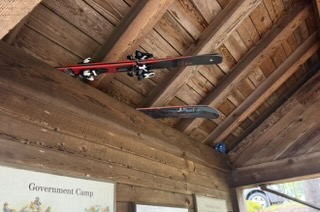
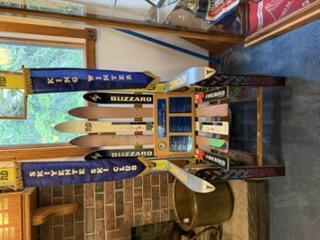
We started out by returning to Government Camp to see the Mt. Hood Cultural Center & Museum. But… they weren’t open until 0900 and it was 0846 so we wandered over to a kiosk which had Oregon Trail information but also had what I think was a music holder, a pair of skis and a snowboard in its rafters. Explanation never came to me.
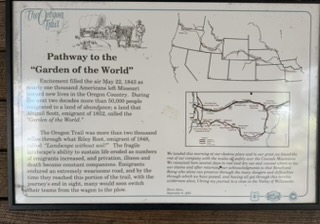
A summary of the Oregon Trail was easier to understand…
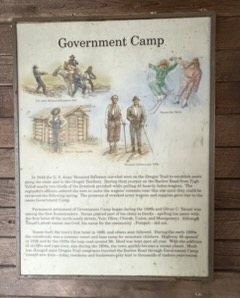
Government Camp became a permanent settlement in the 1890s. Oliver C. Yocum was one of the first homesteaders and proceeded to name streets after himself, Yule, Olive, Church, Union and Montgomery. He named this community Pompeii. The street names stayed but the community name did not stick. He built the town’s first hotel in 1899. During the early 1900s, this town became a summer resort and a base camp for mountain climbers. Highway 26 opened in 1926 and, by the 1930s the loop road around Mt. Hood was open all year. Much has changed since the immigrants traveled the Barlow Road through Government Camp toward their new lives.
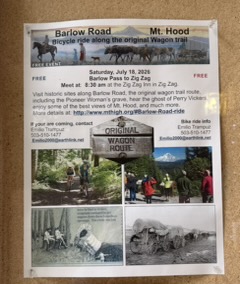
Some are still celebrating the history of the route taken by settlers — as evidenced by this announcement. I can bet they will have a more difficult time retracing the route than we have had on our journey.
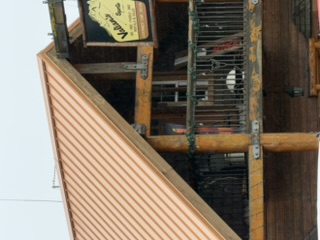
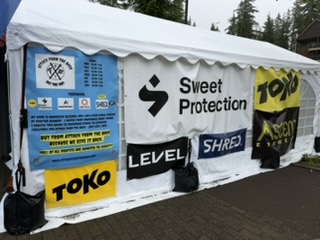
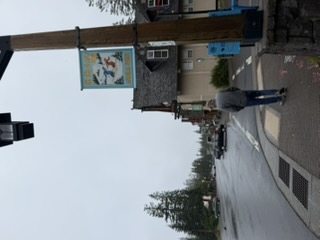
This town is definitely a ski town. But small in size, still with the feel of the sport in the summer. Nearby Timberline and Mt. Hood Meadows were where I skied when I lived in Portland — my first nursing job.
Mt. Hood Cultural Center & Museum
0900 arrived so we returned to the Museum. It was a surprising combination of the history of the area, skiing in general, nature, the CCC and an eclectic feel with unique displays.
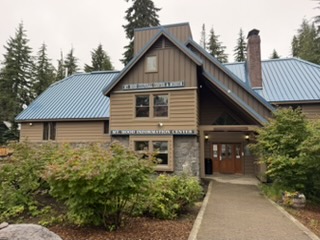
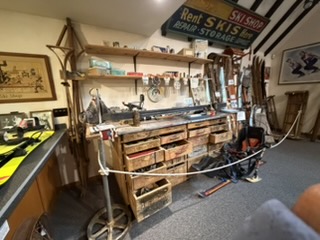
Some of the things I found interesting: an old ski shop where you could get your bindings adjusted, add wax, make repairs. They had donations of skis which went back to the early days. I found a pair similar to the first set I started on, cable bindings and all!
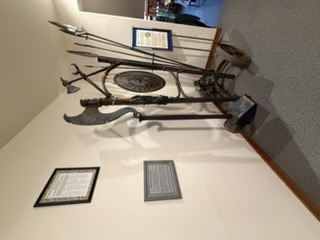
Falling into the “Who knew?” category, this is a hand forged “War Wagon” made by the members of the Northwest Blacksmith Association. This commemorates the First World Championship “Blacksmith Wars” in 2011. Four teams of blacksmiths over four days created a hand forged object using their own design to compete for the title.
The gong was used to mark the beginning and the end of this competition.
Lift ticket prices at Timberline Lodge for the 2025–2026 season:
| Category | Price |
|---|---|
| Child 0–6 | $0 |
| Junior 7–12 | $80 |
| Adult 19–64 | $124 |
| Senior 65+ | $80 |
Compare that to these prices.
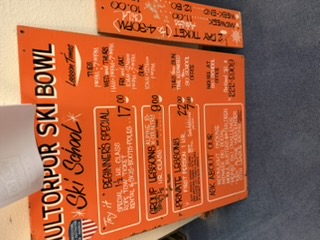
A DIY project for all your old skins…
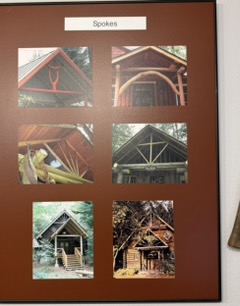
From 1933–1943, the Civilian Conservation Corps, a New Deal program to combat unemployment, provided young men jobs and preserved America’s natural resources. The work they did was primarily in rural areas and related to forestry, soil conservation and park development. They planted over 3 billion trees, constructed 126,000 miles of roads and trails, built flood barriers, shelters and telephone lines. Tomorrow we head to Timberline Lodge which is one of their projects. Below is a replica of another.
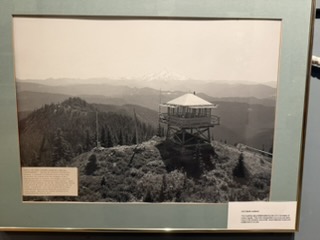
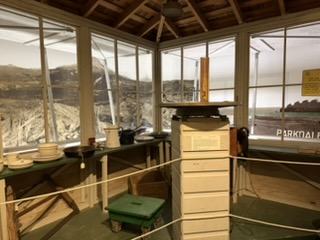
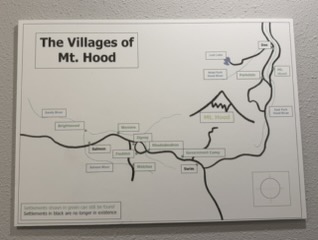
Surrounding Mt. Hood are villages, some of these names are familiar to us as we drove from Hood River to Welches. Brightwood, Salmon, Wemme, Zigzag, Faubion, Rhododendron, Government Camp, Swim, Parkdale, Mount Hood, and Dee.
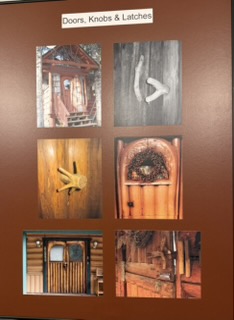
There are some cabins with distinct features built in this area. Swedish cabins constructed by Harry Steiner, a German immigrant who was a master carpenter. He built distinctive log cabin homes. He built his signature cabins out of native materials using hand tools only, and a person can recognize them by the peeled and polished logs, hand-hewn cedar-shakes, the sunburst gable, basalt fireplace, arc-shaped front, and many handcrafted features, such as a door made of a split curved tree, and a gnarled tree root used for a front door handle.
Barlow Road: Laurel Hill
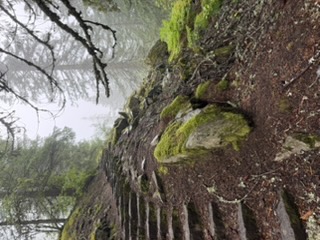
A few places on the Auto Tour we had yet to see… We climbed up the steps which were made into the hill where wagons had to be slowly lowered on the Barlow Road. You get a good idea of the type of terrain the pioneers were dealing with.
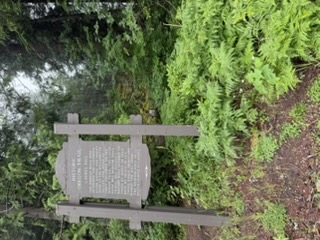
From the 1919 deed that gave “The Mount Hood and Barlow Road” to the State of Oregon:
“To have and to hold unto the said State of Oregon, with all its mountains and hills, its forests and vines, its flowers and shrubs, its valleys and dells, its crags and rocks, its gorges and its canyons, its glaciers and snow-fields, its rivers and streams, its lakes and springs, its animals and birds, its tempests and storms, its lights and shadows, its trails and paths and the beauties and grandeur of Mount Hood: for the use, benefit and pleasure of all forever.”