Whitman Mission
📍 Pendleton, OR to Whitman Mission, WA
Today I am going to focus on the Whitman Mission. We were there to pay homage to Keith’s relatives. To our best calculations, he is three-times great nephew of Marcus.
He asked for and received permission from the National Park Service to lay a bouquet at the gravesite, 190 years after Marcus and Narcissa began their journey west.
We drove to the mission from Pendleton, Oregon. About a 90 minute drive. Well, most days it’s 90 minutes. We had a ten minute stop along the highway for “roadwork.” Keith counted about five miles where we had only one lane to travel on, the other lane being repaved.
First up — a museum: the tale of two societies.
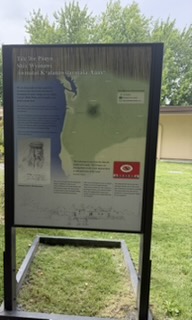
The People of This Land
This was the first sign we encountered:
“We are the people of this Land. Our ancestors have lived here for tens of thousands of years. Today, we are called Cayuse, Walla Walla, and Umatilla. It is good you are here. This land feeds us, clothes us, and shelters us. This Land and ourselves are the same. This Land contains the bodies of our ancestors. For tens of thousands of years we have taken care of outsiders. When travelers first arrived we helped them survive and taught them about this place. These experiences made us wonder about their power. We wanted to understand their ways. So when the Whitmans came, Hiyuumtipe permitted them to build this mission next to a Paasxapuu village. Today, we join the National Park Service in welcoming you here to learn about us.”
The Sager Children
A brief reminder. The Sager girls were spared from death.
The photos showed the four Sager girls — the adopted family members who survived the massacre.
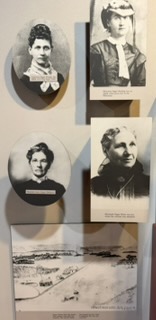
Survivors:
“After supplying all that came with provision and urging all to go on that could, twelve families wintered with us — besides a family of seven orphans whose father & mother both died along the way.”
— Marcus Whitman, May 1844
The Sager children lived at the mission for three years before the Whitmans were killed. Four of the seven children survived the massacre and were held captive by the Cayuse.
Catherine Sager had this to say about mission life:
“We were in school from Monday morning till Saturday noon.”
“The Sabbath was strictly observed… perfect stillness pervaded the house Sabbath morning.”
“In the winter season it was their custom to have a Bible class on Saturday night.”
“Our lessons consisted of eleven verses a week…”
”…(Mrs. Whitman) never permitted us to show any disrespect toward the natives… but we were not allowed to learn the language.”
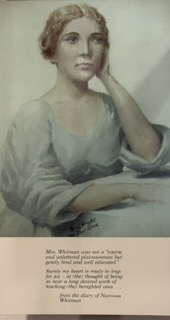
Catherine said that when they first saw Narcissa Whitman at the mission, “we …thought she was the prettiest woman we had ever seen.”
Alice Clarissa
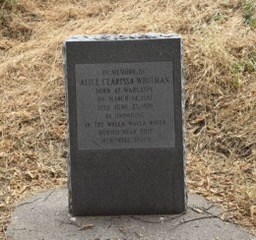
Alice Clarissa was the first white child born on Cayuse land and the only child of Marcus and Narcissa. The Indians called her “Temi,” which means “Cayuse girl.”
She drowned near the mission house in 1839 when only 27 months old.
Someone at the mission once asked Mrs. Whitman if she had any children of her own. Narcissa pointed at the cemetery and said:
“All the child I ever had sleeps yonder.”
Marcus and Narcissa
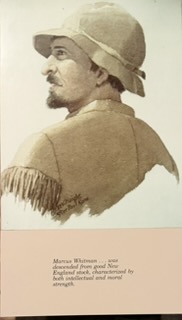
Marcus either did or supervised farming, building fences to protect his crops, taking care of farm animals, milking cows, butchering a horse when needed, sawing logs to make boards, making adobe bricks, and much more.
He held church services for hundreds on the Sabbath, and regularly explained the ten commandments, “and our Saviours first and great commandment.”
He was also still a doctor — but now in a world much different from rural New York. Narcissa wrote that a chief, “Umtippe got in a rage about his wife, and told my husband, while she was under his care, that if his wife died that night he should kill him.”
Narcissa wrote:
“Here we are, one family alone, a way mark, as it were, or center post, about which multitudes, will or must gather this winter. And these we must feed and warm to the extent of our powers. Blessed be God that He has given us so abundantly of the fruit of the earth that we may impart to those who are thus famishing.”
— October 9, 1844
She was lonely for a while but then overwhelmed by “helpers” and those seeking shelter. One visitor wrote, “…she has less help from the other ladies than she might.” Men crowded around the cooking fire for warmth while Narcissa and other “sisters” tried to cook. One man actually used the fireplace for a spittoon.
Mrs. Whitman wrote:
“Oh! I wish I had a little chamber where I could secrete myself.”
In an October 1844 letter she stated:
“I cannot write any more, I am so thronged and employed that I feel sometimes like being crazy, and my poor husband, if he had a hundred strings tied to him pulling in every direction, could not be any worse off.”
Her greatest treasure was her daughter, Alice Clarissa:
“Dear child, she is a great solace & comfort to her mother in her lonely hours…”
Cayuse Life and Culture
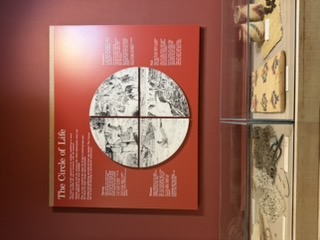
In the first photo, the Circle of Life, Indian women gather food. Families moved with the seasons. In late spring and early summer women dug for cows roots and bitterroot. In fall camas bulbs were collected. Life had a variety that was close to the hearts of the People.
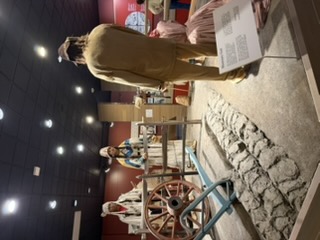
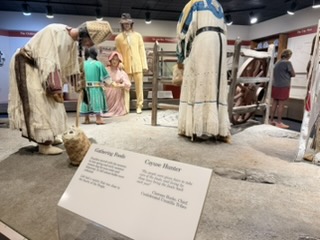
Below, on the right, a Cayuse hunter.
“The people were given laws to take care of the foods, and living by those laws bring the foods back each year.”
— Clarence Burke, Chief, Confederated Umatilla Tribes
“It’s a natural instinct for the Indian to pass on his culture. It starts with the stories we tell our grandchildren. When you are intelligent, you can look at the past and know it is important to preserve your culture. The Indian People still hold to our traditions, but education is important. Our children need to know how to live in the white world too.”
— Co-Chief William Minthorn
“Although the Suyapos (white people) brought evil, they also brought a manner of living that tempted the Indian with food, new weapons, and other luxuries he had never known.”
— Click Relander
Where did they go?
By 1850, “The Cayuses had not been defeated but they were nonetheless shattered as a tribe. Already weakened in numbers by the measles, and now more so by the skirmishes and the flight, they dispersed in small groups along the Bitterroots, a few living with the easternmost Nez Perces, Flatheads, Coeur d’Alenes, and with still other tribes in the buffalo country farther east.”
— Edwin Thompson
At the Gravesite
After the tour of the museum, it was time to climb to the graves of Narcissa and Marcus.
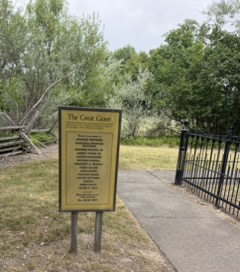
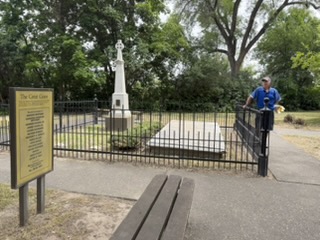
Keith and I walked up first so he could have a moment alone with his thoughts. About twenty of our Airstream friends joined us for a short prayer he had prepared.
“Today we gather at the resting place of Marcus and Narcissa Whitman. Just as my mom and her brother before me. We all came here with quiet hearts carrying memories, carrying history, and carrying love.
Let me pray with you.
Eternal God we stand here remembering Marcus and Narcissa, their courage and devotion and the lives they touched. Their journey started in 1836, 190 years ago, ending in tragedy in 1847 and their story continues for the generations that remember them.
Hold them now in your eternal peace. Let the ground that cradles them be gentle and the light that guided them in life guide them still. We also remember all the pioneers who suffered in that time. Every life changed, every life lost. Your mercy covers them all.
Grant us the wisdom to carry their memory with honesty, humility and compassion. Help us walk forward as people who seek understanding, healing and truth.
And for Marcus and Narcissa may their spirits be at rest with their names being spoken with tenderness. May their memory be a blessing to those who stand here today and to those who come after. Amen.”
He then laid a bouquet on the grave.
“History, despite its wrenching pain, cannot be unlived, however, if faced with courage, need not be lived again.”
— Maya Angelou