Two Weeks!
📍 Ash Hollow State Historical Park · Lake McConaughy, NE
Two weeks?!
We sit in a state campground with generous spaces — sites are set up so you can’t see your neighbors. Today we took two passengers sightseeing.
Keith read from Narcissa’s diary tonight. She remarked that when they arrived near here, there wasn’t much grass and no water for the cattle. We have now traveled one-third the distance of the Oregon Trail in the days we’ve been together. The pioneers could only manage 10–12 miles per day.
(Trivia: we’re parked near a dam over Lake McConaughy. Matthew McConaughey has an Airstream — a customized 2004 International 28ft.)
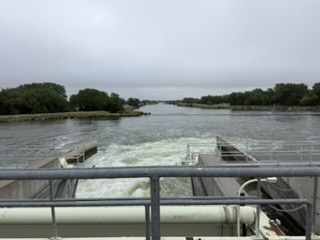
This morning Keith walked along the dam and saw the whitecaps and spillway. No canoeing today.
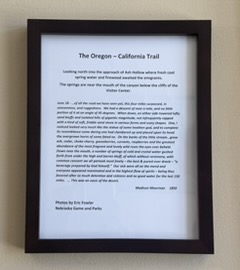
Ash Hollow
Our leaders headed out around 0900 to get to their posts at Ash Hollow — one at the Visitor’s Center, one at the trail overlook where pioneers came over the hills after crossing the Platte River.
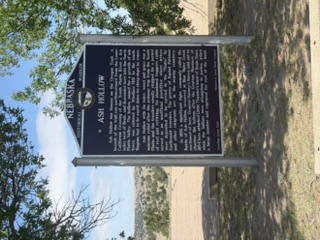
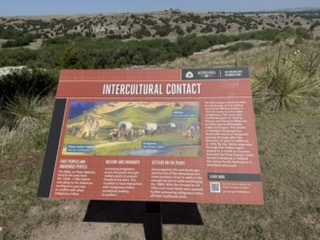
At the museum we learned more about how soldiers played into pioneer protection, and saw many artifacts that had been found and preserved.
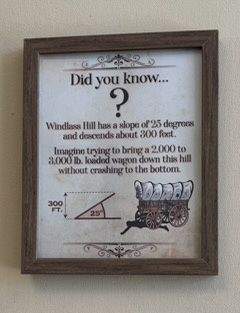
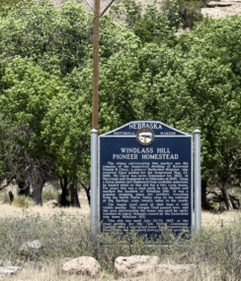
Windlass Hill was steep and had to be descended. Pioneers devised several ways to lower their wagons down the side without losing everything inside.
Larry pointed out a little item in one of the collections. Check out the corkscrew they used to open their bottles of wine. It hasn’t changed much over the years…
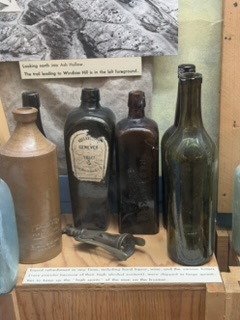
A lot of deaths on the trail were due to drinking tainted water. Many pioneers died of cholera.
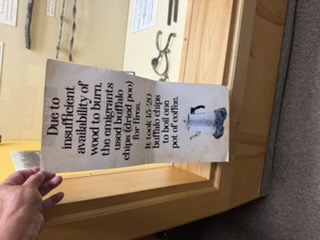
Meanwhile, I have a very nice setup for my morning coffee:
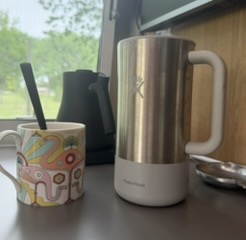
The pioneers had to use buffalo chips to heat their pots.
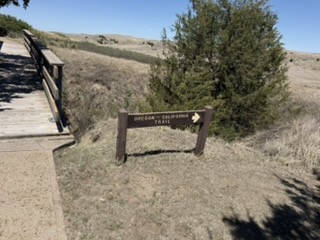
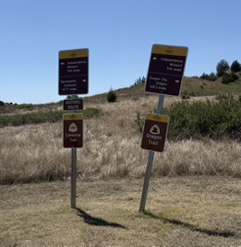
Windlass Hill — The Descent
Due to limited parking for our large trucks, we split the group in half to see the sights. The second site was the area where wagons had to be lowered down.
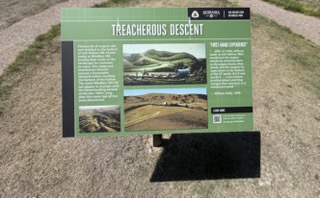
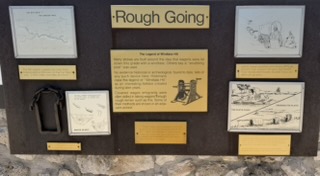
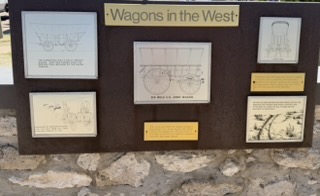
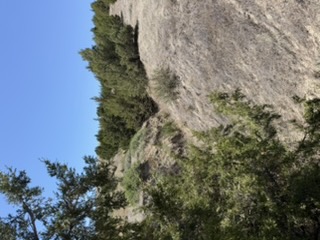
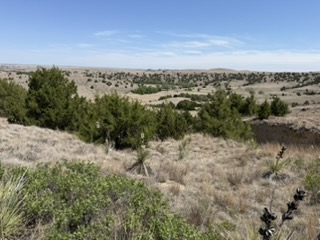
It was a steep climb to the overlook but — with a few rest stops for some of us — we made it to the top. Our ranger explained that the soil here is sandy, and rain wipes out individual ruts over time. So many wagons traveled the same pathway that what’s left are deep, wide swaths where the grass grows differently — the soil ground down by thousands of passings.
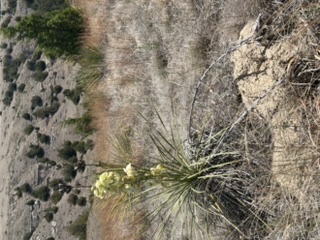
Soapweed Yucca
These flowers are beautiful but not indigenous to the area — they have deep roots, and when rangers spot new starts, they try to dig them up. I know firsthand that the leaves have very sharp edges.
Soapweed Yucca: its roots can be crushed to produce a lather for soap or shampoo. It also serves as host for the Yucca Moth — the only insect capable of pollinating its flowers.
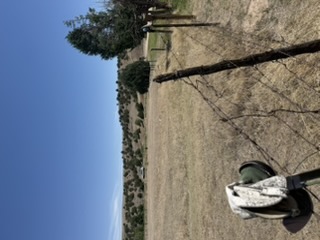
Boots on Fenceposts
Coming out of the Windlass area I saw boots hanging upside down on fence posts. There are apparently four reasons for doing this:
- Honoring a fallen horse or cowboy — upside down symbolizes a life’s work completed
- Signals that a rancher or farmer is at home
- Markers for property lines
- (The fourth reason remains a mystery…)
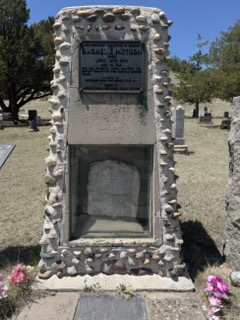
Ash Hollow Graveyard: Rachael Pattison
We stopped at the Ash Hollow Graveyard, where a pioneer woman’s grave had been discovered.
Rachael Pattison was 18 when she married — and immediately set out on the Oregon Trail. She and her husband were only two months into the journey when she became sick with what they believe was cholera. She fell ill in the morning and was gone by nightfall.
Her husband stopped along the trail to carve a headstone for her. It was later found and is now protected from the elements. Many pioneers who died along the trail were buried in shallow graves with no marker at all — there simply wasn’t time to stop. But Rachael’s husband, Nathan, stopped to do this for his young bride.
Tomorrow we are “launch crew” — tasked with checking everyone out and making sure no one leaves anything behind. Keith isn’t thrilled, since he likes to be off early. A laundry run tonight catches us up on cleaning duties. Heading to Gering, NE — a 2.5-hour drive.
“Travel is fatal to prejudice, bigotry, and narrow-mindedness.”
— Mark Twain